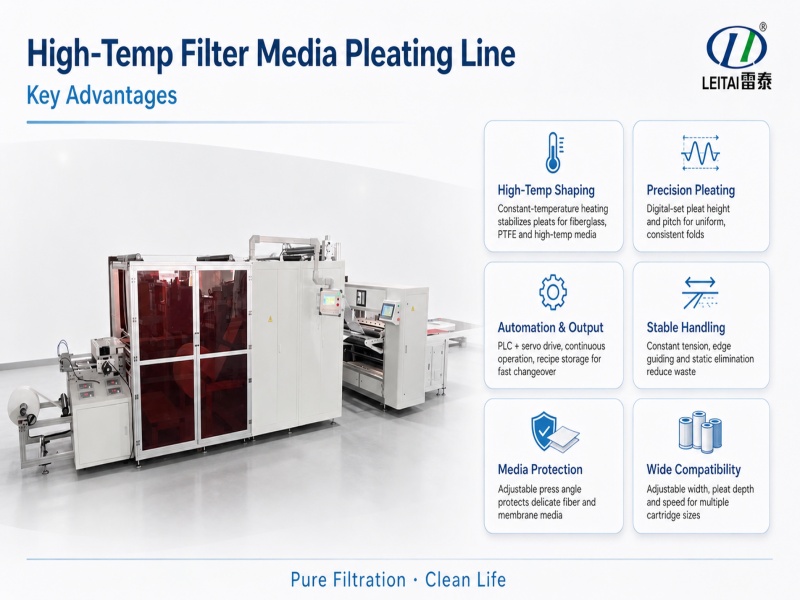
The advantages of this fully automatic high-temperature-resistant filter paper creasing production line can be evaluated in terms of process adaptability, forming quality, production efficiency, stability, and downstream finished products:
I. Strong Adaptability to High Temperatures
Compared to pleating machines with partition, this machine is better suited for the production of high-temperature-resistant filter cartridges designed for high-temperature operating conditions.
Equipped with an independent constant-temperature heating and setting unit, the upper and lower heating plates heat up evenly, allowing for the preheating and setting of filter media—such as fiberglass, PTFE, and high-temperature-resistant PP—that are prone to springing back and difficult to set. Once folded, the pleats remain crisp and do not easily spring back.
II. High Precision and Consistency in Pleat Formation
The pleats are formed with precision using specialized tools; pleat height and spacing are digitally set on the touchscreen, ensuring tight tolerances on pleat depth and consistent width and height across the entire batch of pleated panels.
Neat and uniform pleat formation ensures a consistent airflow path and stable resistance, thereby guaranteeing the filtration area and making the airflow rate and efficiency of the finished filters more controllable.
III. High Degree of Automation and High Production Capacity
Controlled by a PLC and touchscreen, with independent servo drives for each workstation; unwinding, feeding, pleating, and cutting can operate continuously and automatically with minimal manual intervention.
Capable of storing multiple sets of product process recipes, which can be recalled with a single button press when changing specifications, resulting in short setup times; pleating speeds for models in this series reach high levels, making them suitable for high-volume production.
IV. Stable Material Feed and Low Defect Rate
Equipped with constant tension control, guide and alignment correction, and antistatic features, the filter media feeds straight without deviation, and prevents dust from adhering to the surface of the filter paper.
Unstable material feed is the primary cause of skewed pleats and uneven thickness; this system significantly reduces the defect rate.
V. Protect the Filter Media
The angle of the pressing mechanism can be adjusted according to the thickness of the filter paper. When used in conjunction with specialized pressure plates or rollers, this prevents the filter paper from being crushed or damaged during the folding process, making it particularly gentle on brittle fiberglass and thin, coated filter media.
VI. Wide Range of Applications
The pleat width, pleat depth, and line speed can be adjusted within a certain range, making the machine compatible with filter element pleats of various specifications and materials. This single machine serves multiple purposes, reducing the need for specialized equipment.
VII. Ease of Operation and Maintenance
The human-machine interface is intuitive, with parameter settings and count control centralized on the screen, allowing workers to get up to speed quickly and making training easy.
The frame is primarily made of aluminum alloy; the rollers are chrome-plated, and the bearings are wear-resistant. The open design facilitates cleaning and routine maintenance, resulting in a low failure rate during long-term operation.
VIII. Benefits for Downstream Finished Products
Uniform pleats → Better fit and reliable sealing during filter assembly;
Unobstructed airflow → Low initial resistance and reduced fan energy consumption;
Stable shape → Filter elements are less prone to collapse or deformation during transportation and use, resulting in a longer service life.
 Service Hotline:



 Get Quote





 IPv6 Network Supported